Image

Carol of the Shells

“We must be willing to let go of the life we have planned, so as to have the life that is waiting for us.” –E. M. Forster

I collect seashells. More accurately stated, I am constitutionally incapable of walking near any ocean body without searching for seashells. So when Steve and I spent a week at Holden Beach, North Carolina back in July, I was combing the shoreline, back bent, eyes peeled, within hours of our arrival.

We did go night-shelling--Steve's a patient man!

We did go night-shelling once–Steve’s a patient man!

I didn’t find a lot that first day: a few baby’s ears and some slipper shells, which appeal to the little girl in me who can’t help but think of doll shoes. Steve–-who isn’t a sheller but does love a good beachwalk, and so indulges me–-found a beautiful olive. I swooped down excitedly more than once, thinking I’d found a moon snail, only to be disappointed when I’d pick the prospect up. A lovely whorled front would have the back cracked off, or, if the back was whole, the front had large holes in its fragile top curve. Barnacles marred one, having made their home on its swirl.

When I first started shelling, I would often pick up blemished shells. I would settle for the conch with a hole in the back, or a slipper shell with a chipped, jagged edge. The pickings were often slim, and I didn’t have the patience, or maybe the fortitude, to leave the broken shells on the beach. Sometimes the brilliant coloring or the graceful whorl exposed in a fractured shell looked too beautiful, even in its brokenness, to leave behind. Besides, if you turned them just the right way, looked at them from just the right angle, you couldn’t see their flaws. Still, they never seemed quite so impressive once at home as they had at the beach. When I grew tired of the fragments cluttering my collection, I decided I needed to raise my standards. I vowed then to collect only perfect specimens: bright color, shiny finish, completely whole with no marks or blemishes. But therewith came the problem of the perfect: such shells were elusive. There were few, if any, to find. Continue reading

Image

Romance Counts

My fiancé Steve and I see the world differently. He likes to tell the story of how, when we were trying to remember whose toothbrush was whose, he determined ownership by recalling his brush was on the left, mine on the right, whereas I identified our respective implements by color: his green, mine blue. A similar scenario occurred trying to recall which mug belonged to whom—I checked the colors of the teabag tags, remembering Earl Grey was yellow, English Breakfast red, while he’d noted he’d placed his mug to the left. He relies on spatial relationships for identification and cueing. I inevitably register color first.

Colorful blooms caught my eye at the Grove Park Inn

Colorful blooms caught my eye at Grove Park Inn

The point here isn’t that we middle-aged folk keep forgetting things; the point is the differences in how our brains work. Steve has a mathematical, map-guy mind that tends toward a linear, laser-point focus; I’m a creative, crafty type, with a heightened aesthetic awareness, my attentions more diffuse. More than once while traveling, we’ve passed some wacky, hard-to-miss building or sign, or a group of deer hovering on the side of the highway. Each time, Steve was so focused on the road in front of him that he missed anything not represented on the GPS. (Note: generally speaking, a driver’s ability to keep eyes on the road is a plus!) And of course, there’s shopping: if Steve’s targeting shirts, he looks at shirts, and nothing else registers. I am almost incapable of filtering out all the pretty items on the periphery, especially those in my favorite colors.

Our minds clearly process information in wildly different ways, and while this is true for all couples to some degree, our obvious disparity carries the distinct benefit of preventing romantic relationship pitfall #11: believing that true love creates magical mind-reading powers.

To whit: we don’t even see our toothbrushes the same way. Any expectation that the other could consistently and accurately conjure up (and then fulfill) our deepest thoughts and desires borders on absurdity.

But it’s good intel. Because that knowledge reinforces the importance of romantic relationship lesson #23: you have to ask for what you want. Continue reading

Image

Breaking Cake Together

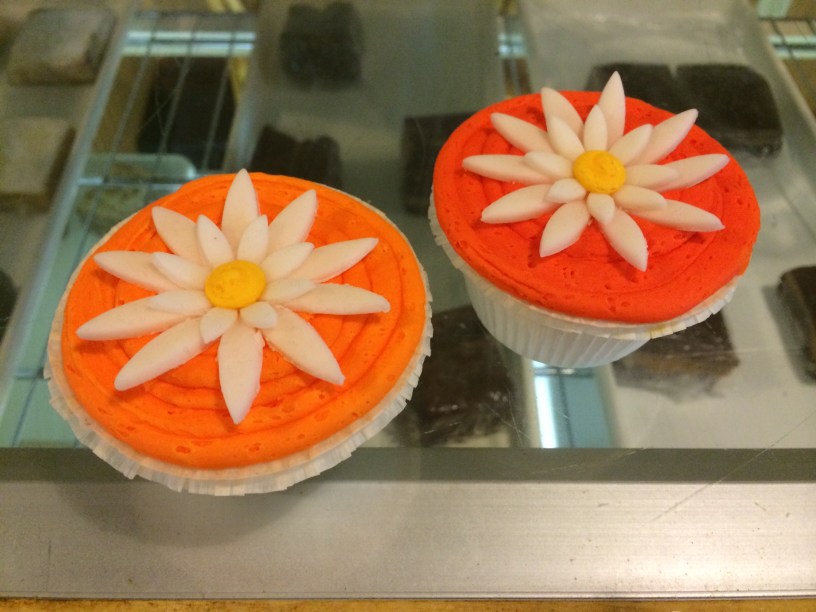
Once we had a venue selected and booked, it was time to turn toward securing other vendors. The choice of where to focus next was obvious: the cake.

It’s all about priorities, people.

The tradition of wedding cakes, according to a fascinating history by Carol Wilson in Gastronomica, dates back to antiquity: “Ancient Roman wedding ceremonies were finalized by breaking a cake of wheat or barley…over the bride’s head as a symbol of good fortune,” after which the bride and groom would share a few of the crumbs. I’m certain many brides were grateful when this custom (also the precursor to modern-day confetti, says Wilson) morphed into a somewhat gentler crumbling of the cake over the head. Still, both rituals are a little too similar to the disturbing contemporary trend of the bride and groom shoving wedding cake in each others’ faces. Because nothing says I love you like frosting ground up your nose.

I’m equally glad we’ve moved beyond Yorkshire’s “Bride pie” (1500s-1800s), which Wilson describes as consisting of “a large round pie containing a plump hen full of eggs, surrounded by minced meats, fruits, and nuts” and decorated with “ornate pastry emblems.” It sounds like a cross between a Turducken and a fruitcake, and the fertility symbolism is a little less than subtle. According to Wilson’s history, it wasn’t until the late 1700s that a sweet cake finished with white icing became a common part of English wedding celebrations. Continue reading

Image

Steve Speaks: FsSTG meets FsFTB

FsFTB readers: Every so often my fiancé Steve will be chiming in with a post of his own—this is his first! 

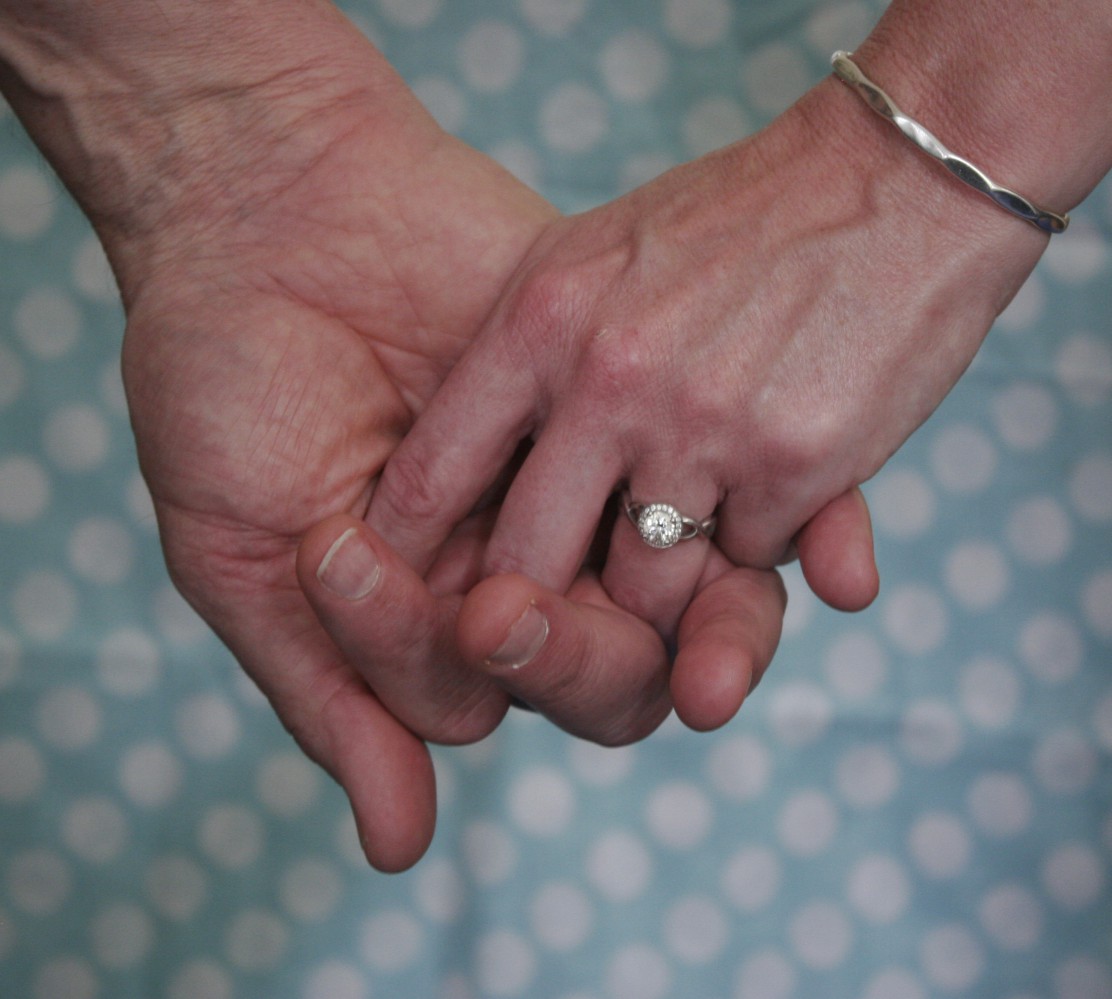
Hello. My name is Steve, and I’m a fifty-something second-time groom.

I’m honored but somewhat intimidated to be invited to guest-blog here. I write a lot as a member of the forestry faculty at a state university, but what I write for work is mostly scientific and technical stuff about maps and carbon sequestration. Don’t worry—there won’t be trees or maps in this post! For balance, my forty-something first-time bride, Sandee, has invited me to tell my story, that of the fifty-something second-time groom. With two grown sons. And a dog. So to start: how can I discuss what the “second time” means without acknowledging the first time?

I was married in 1985 to Karen, a forester who worked in South Carolina when I worked in Georgia. We became engaged less than a year after we started dating, and there were fewer than six months between engagement and marriage. Quick, huh? I’d gotten a job offer in Alaska, which meant a compressed schedule for the wedding. We married in March in upstate New York, and our honeymoon consisted of a cross-continent roadtrip in a pickup truck with her golden retriever, followed by a three-day ferry ride from Seattle to Haines, Alaska, and a two-day drive from there to Anchorage. (Sandee and I don’t know yet where we’ll be going for a honeymoon, but let me go on record here as promising it won’t involve a dog and a pickup!)

Karen and I had twenty mostly very happy years together. The last twelve were under a slowly darkening cloud after she was diagnosed with multiple sclerosis. She died in January 2006, closing a chapter in my life and changing the nature of the family that remained: I became a single dad raising two teenaged sons. As it tends to do, time has healed wounds and filtered memories, so that most that remain are the good ones, and I look back on what we had with fondness, love, humor, and gratitude.

Steve&Tucker2

With oldest son Tucker

Fast forward: there’s this house on the end of my street. The yard is not very well kept. Holiday decorations appear only sporadically. Three guys, plus one canine (born male but subsequently modified), live there. Two of the guys are recovering adolescents; the other has gray in his beard as a result. It’s a testosterone-rich, estrogen-deprived zone, and you can tell it by the décor. And the state of the bathrooms. So, who is the guy who owns that house?

Well, I guess that would depend on who you ask. My neighbors see the guy with the unkempt yard. My students see a professor. My sons see a father, and my dog…well, judging by his greeting, I think he sees me as the center of the universe!

As I left my teens and progressed through adulthood, I tended to identify my “self” with the primary role I was playing at the time. I was a flannel-shirt-clad forestry student during college and graduate school. When we moved to Anchorage and our initial friends were all from Karen’s recreation-league soccer team, I became “Karen’s husband.” To those in the forestry company, I was the guy in charge of the number-crunchers in the technical department. When my boys started playing sports and joined scouts, I became identified as “Tucker’s Dad” or “Dusty’s Dad.” Returning to academia as a professor, I was the guy going up for tenure in his forties. Later, I became the guy who lost his wife. Continue reading

On Gratitude and Gay Marriage

I’m a middle-aged fashion model. According to conventional industry standards, I’m neither tall enough, thin enough, nor young enough to qualify as model material, but that’s one of the main reasons I took on the challenge: I wanted, in my own small way, to expand our narrowly defined ideas of what constitutes “beauty.”

I’m no pro, nor do I aspire to be, but I model fairly regularly with a volunteer organization that promotes diversity in fashion and the fashion industry. Back in June, we did a runway show at a local gay bar and dance club to support the launch of a new LGBTQ magazine. As we dressed backstage before the show, one of the other models, “Kesha,” a stunning African-American woman maybe ten or twelve years younger than me, commented on her wedding planning progress. When I told her I’d recently gotten engaged, too, she said, “Congratulations, girl!” gave me a big hug, and noted, “We need to talk.”

After the fashion show, Kesha and I sat in the club’s bar, drinking wine and sharing nuptial details. Her wedding is slated for this coming spring, so she’d already booked her venue, the Patrick Henry ballroom, and chosen bridesmaids’ dresses, floor-length Tiffany-blue gowns. We talked colors, sharing pics back and forth on our phones: her centerpieces, my vases. She’s planning on two dresses: for the ceremony, a fitted mermaid gown with beading and bling; and for the reception, a mini-dress with a frothy full-length tulle overskirt. As we clicked through pictures, one of us spotted a cat on the other’s phone, so we took a detour into trading pet photos. I’d modeled with Kesha for over a year, but this was the first real conversation we’d had. Weddings, it seems, have a way of bringing people together.

Continue reading

Gallery

Perfectly Imperfect: Beauty, Brokenness and DIY Decor/Before

“Imperfection is beauty, madness is genius, and it’s better to be absolutely ridiculous than absolutely boring.” -Marilyn Monroe

Perhaps one reason I resist aspiring to perfection is my long-time love of vintage and antique goods. Perfection is a shiny veneer, pretty enough to look at, but usually a temporary state—and, frankly, a little boring. Wear and tear tells a story: a little rust lends a venerable charm, a few dings show an object was used and valued, a crooked hand-sewn seam or repair imbues an inanimate linen with tangible humanity. The Online Etymology Dictionary describes the root of “imperfect” as deriving from the “mid-14c., imperfite, from Old French imparfait, from Latin imperfectus ‘unfinished, incomplete’.” All of the imperfect objects in the gallery, above, were found at thrift, consignment, or antique stores, and all will become part of our wedding decor. When I look at them, I see the beauty in their imperfections, and the possibilities in that beauty. They are indeed “unfinished and incomplete,” though my goal is not to “perfect” them, only to highlight their inherent loveliness and enhance it by finding fresh uses for familiar things.

“To banish imperfection is to destroy expression, to check exertion, to paralyze vitality.” – John Ruskin

Continue reading