What does Renee Zellweger’s face have to do with my getting married?
Nothing. And everything.
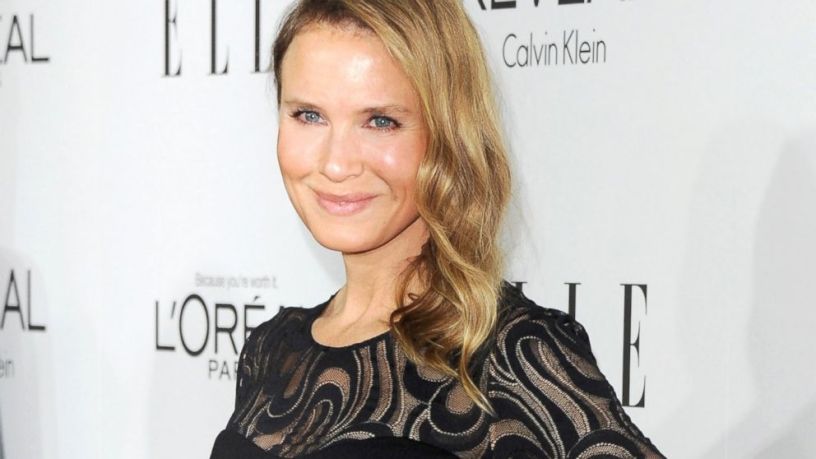
On the off chance you’ve missed the approximately 24,372 (make that 24,373 now) articles, blogs, and tweets on the subject, actress Renee Zellweger made the news recently when photos of her taken at the ELLE Women in Hollywood Awards revealed some changes to the 45-year-old’s visage. Zellweger, most famous for her turn as the title character in the Bridget Jones movies (personally, I thought her most fabulous in Chicago), has been out of the public eye for much of the last four years, and her recent appearance–in all senses of the word–has lit up the internet for days with speculation (and castigation) about the reasons behind her altered look. I’ve hesitated to throw my hat in the ring (it protects against sun-damage, you know), but this FsFTB is ready to lay a few things bare.
Two thoughts. The first (A) is about perspective, in a fairly literal sense. As someone who has been in front of a camera a fair amount, having performed for much of my life and taken up modeling in my later years, I can see that some of the apparent differences in Zellweger’s appearance are quirks of lighting and angle, combined with the fact she’s wearing minimal makeup. The one shot that is getting the most airtime, the one in which folks are exclaiming she looks “unrecognizable,” is simply an unflattering picture. In other recent photos, some taken at the same event, she is recognizable. Yes, her eyes appear a bit wider, her brows less sculpted, and there are some crow’s feet in evidence, but she looks fine.
As a photographer friend of mine has pointed out, our bodies are living matter in motion, our faces and expressions dynamic and ever-changing. A photograph, in contrast, captures an isolated moment, one second of stillness in a lifetime of movement. Sometimes the result is an accurate reflection of reality; sometimes it is idealized; and sometimes it’s just…not. Most of us have had a picture taken that surprises us, and whether you love or hate that photo depends on the nature of the surprise: did the photographer catch a moment of heightened beauty–a just-right tilt of the head, a bold, happy laugh–or click the shutter the second your lip curled sideways and your left eyelid twitched shut? Even stunningly beautiful people take ugly pictures. Ask someone to follow you around and take 50 random photos as you walk, laugh, sing, etc., and see if there isn’t at least one that makes you say, “I don’t look like that!”
Yes, you do. Or at least you did during the split second the camera caught your mouth half-open and that weird shadow bisected your face, making one nostril look like a black hole.
Not to mention that so many of the “It’s so shocking!” comparisons show Zellweger’s recent photo next to ones taken of her six and eight and ten years ago. Seriously, do you look the same as you did ten years ago? If I put a picture of myself from ten years ago next to a current photo, my first thought is, “Hey, gravity works.” My second is, “I look happier.” Most days I consider that more than a fair trade.
So that’s (A). (B) is more complicated, and more important.
(B): It’s her face.
It’s nobody else’s business what Renee Zellweger does or doesn’t do with her face. If she wants to get a 3-D tattoo of a monarch butterfly appearing to land on the end of her nose for all of eternity, she can. I can’t say I, personally, would find it an attractive choice. But it’s her face.
Why am I obsessing about this? Because gravity does work, and quite well, in fact, as I can scarcely forget when every bridal magazine and wedding website flaunts the smiling faces of blushing young brides, with their taut, smooth skin and well-defined chins. I’ve been toying with the idea of whether–before we pay lots of money for lots of wedding pictures–I might want to do a little something to counteract its forces. I’d like to think that if I decided I wanted a little Juvederm or a laser peel or some other cosmetic boost to my forty-something face (and confidence) before my wedding day, my friends would shrug and say: it’s her face. But I’ve heard people not only express shock and anger at the pressures society places on women like Zellweger to maintain an impossible ideal of eternal youth and beauty–a fair target of their wrath, and a concern I share. I’ve heard just as many criticize and judge Zellweger herself for, as they see it, caving to those pressures. It makes me wonder what kind of censure or disappointment I–whose ability to be competitive in my profession does not, thank god, depend on the definition of my jawline–might engender were I to make a similar choice.
Why can’t I–she–we–just grow old gracefully? Believe me, I want to. I want to accept my aging self with all its puzzles, pleasures, and idiosyncrasies, physical and otherwise. But what do we mean by “growing old gracefully,” anyway? Does working out regularly fall within the parameters of “graceful”? What about hiring a trainer? If your motivation to get fit is as much about maintaining your youthful figure as it is maintaining your health, is that a little less than graceful? What about wearing sunscreen, or dyeing your hair? Using anti-wrinkle cream? Getting a chemical peel? An injection? Liposuction? An eyebrow lift or a tummy tuck? Where exactly does one cross the line from aging gracefully, to tripping up occasionally, to full-on fisticuffs minus concern for health or dignity?
I’m not considering going under the knife, and honestly, even the idea of Botox freaks me out a little. I’ve never had anything beyond a basic facial, and I’m still debating whether I ever will. But I was deeply disturbed by the responses to Zellweger’s photos. In her profession–as saddening and maddening as it is–getting work done is often a savvy business decision. The fact I hate that does not make it any less true, and condemning her for “selling out” doesn’t solve the real problem. It’s particularly distressing to me that some of the same women who fight for a woman’s right to make her own decisions about her uterus are equally quick to tell her what she can and can’t do with her face. I know the anger comes from a good place–a desire for a better world, a world in which women are treated as whole humans. And it’s true that when women like Zellweger take dramatic measures to prolong the appearance of youth, they perpetuate unattainable and unrealistic ideals of beauty and perfection, distorting our idea of what a real woman’s body or aging face looks like. Those distorted ideals are genuinely damaging, and I, too, have wished more celebrities would allow themselves to age naturally, be role models, and reduce the pressures on us all. Perhaps if they did, eventually, we’d rid ourselves of those unattainable standards altogether.
It’s a beautiful dream. And it is a lot to ask.
Yes, women in the public eye are role models, whether they like it or not. They have power to inspire change. AND they are also individuals with agency, and if I’m going to argue that a woman’s body is her domain, then her face is in country, too. On the one hand, I would love it if women in the business of beauty would take a stand to create a world where real, natural beauty was accepted and admired, aging faces and bodies respected and revered. On the other hand, I don’t think I get to insist that Zellweger sacrifice her right to make choices that might extend her career or bring her more confidence as she navigates a world that’s less than welcoming to the middle-aged. Feminism is about choices, and…it’s her face.
The problem is not her face, or mine, or gravity. The problem is that we live in a world in which women are dismissed if we aren’t youthful, thin, and beautiful, and shamed if we take too many (obvious) measures to become or remain so. Our faces and bodies, far too often, are battlegrounds, political pawns, fodder for the next news cycle. They are regulated and legislated. The least we can do for one another is to refuse to add to the daily barrage of messages that declare our bodies are not ours to determine. The least we can do is claim our bodies, our faces, our crinkly crow’s feet and wise smiles, for ourselves.
It’s a gorgeous, sunny autumn afternoon, perfect for a walk. Now, where did I toss that hat?


 Forty-Something First Time Bride