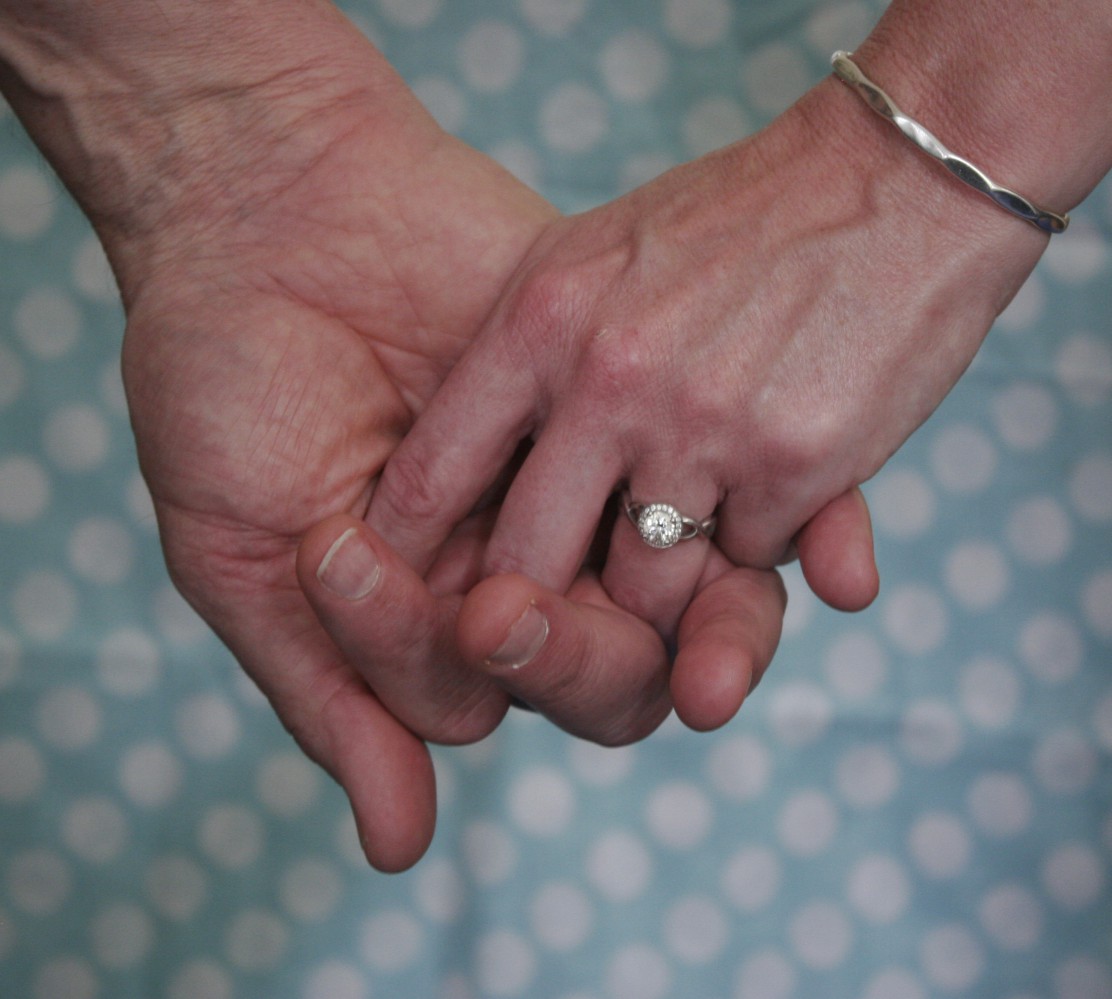



Five reasons to marry a man who likes to dance

1) He’s far more interested in having fun with you than he is worried about maintaining a particular image. He sheds self-consciousness, takes risks, and lives in the moment.

2) He’s a doer, not a watcher, and definitely not a wisher-watcher: he doesn’t sit on the sidelines, wishing he could dance, watching others have a good time. He throws in. He’s right there beside you.

3) He can take the lead when the situation demands it. Not in an old-fashioned the-man-is-the-head-of-the-household way, but in a he’s-a-grown-up and when-it’s-his-turn-he-steps-it-up way. Because that’s what adults do, unless they’re doormats or over-sized kids. When called upon, they step up and lead.

4) He also knows how to step back and listen. Dancing together teaches you to sense and respond to changes in the music, to pacing and mood, your partner’s rhythms. A man who likes to dance knows how to tune in, pay attention, and adapt. This is the counterpoint to reason number 3, and every bit as important.

5) Dancing is fun, sexy, and publicly sanctioned foreplay. Need I say more?

Let’s dance!


Photos by Noah Magnifico, our wedding photographer.  More on Noah and his work coming soon!

Image

Bratty Bride Goes Shopping

If “Bridezilla” and some of the other wedding reality TV shows are to be believed (and I’m not so sure they are—no bride I’ve known has had anything so much as resembling a meltdown), there are at least a few ladies who think their “bride” status entitles them to be bossy, demanding, and downright rude. Planning a wedding can be stressful and time-consuming, but whenever I get the urge to complain, I try to stop and remind myself of one key thing: every last piece of it is a privilege.

It’s a privilege to have found a partner who returns my love and shares a desire to commit to a life together. It’s a privilege to have caring family and friends with whom to celebrate our joy. And it’s privilege to have the resources to throw a party with beautiful decorations and  abundant food and drink. These are not things to be taken for granted, and they’re assuredly not a license for temper tantrums and testy outbursts.

So I’m confident “Bridezilla” is well beyond my basic crankiness capabilities.

I’m embarrassed to admit that a little alter-ego I’ve come to call Bratty Bride is not.

 Meeting Bratty Bride

When you’re planning a wedding, everyone, it seems, has an opinion. Vendors and wedding professionals—the photographer, the florist, the DJ—are supposed to have opinions; you pay them well for their expertise, and when they share their knowledge, it impacts your vision and helps you make decisions. But then there are, oh, say, the overly enthusiastic dental hygienists, or the nosy sale clerks whose advice seems entirely derived of their own nuptial dreams and utterly divorced from the reality of yours.

It was whilst I was on the receiving end of such advice that I first met my inner Bratty Bride. Continue reading

Image

The Wedding Present

Steve and I received our first wedding present shortly before Christmas. Steve’s mother Judy, a widow who lives in a retirement community outside DC, asked us to visit so she could give us a special wedding gift, a crystal wine decanter. The decanter had been a present to her and her husband Jack, Steve’s father, when they were married in Tampa in 1954.

In a note she sent to Steve, she indicated she wanted to give us the decanter now while she still felt in reasonable control of her health. Her vision is failing, as is her memory, and she’s aware of her fading faculties. We’d wanted to make a visit anyway, as her 85th birthday fell in early December, and we knew we’d be away for the holidays. So we drove up to take her out to dinner and sit for a while.

Steve and his mom Judy

Steve and his mom Judy

Petite, with short gray hair, Judy welcomed us warmly with hugs when we arrived. Despite her frailty, she carries herself with poise. After dinner at an Italian restaurant, she gave us the decanter, wrapped carefully in a towel and tucked into a handled shopping bag. It is a striking piece with family history, and I felt honored she wanted to pass it on to us. As we chatted, her frustration with her increasing limitations became evident. She struggled to see the particulars of the engagement photos we’d brought her as a gift, and when she’d begin to tell a family story she would often frown and pause a few sentences in, shaking her head. “Now, where was I going with that?” she’d say, and give a rueful laugh. She held significant events fairly clearly in her mind: she knew we were soon headed to England, and that she would be spending Christmas day with her daughter’s family. But the finer details frayed at the edges, and sometimes the thread was lost altogether. Continue reading

Image

A Whole Lot of Wonderful (with a Little Bit of Ick)

Happy New Year! It’s still kind of hard to believe that 2015 is our year: the year we’ll tie the knot. Wow. And…wow!

I don’t know if it’s true that one’s New Year’s Eve experience is a harbinger of the year to come, but our conclusion of 2014 was a microcosm of the mixed bag that is marriage (and life): a whole lot of wonderful with a modicum of miserable thrown in to keep us humble. The wonderful: we concluded an amazing trip to England, where we spent Christmas and New Year’s visiting Oxford (Steve’s youngest, Dusty, is studying there), London, and Stratford-upon-Avon. It was an incredible week: attending midnight Eucharist at St. Mary’s church in Oxford, drinking cider at a tavern older than the United States, touching an English yew in the botanical gardens planted in 1645. After days spent viewing London from the top of the Eye, watching the ravens at the Tower, and seeing a moving performance of Love’s Labour’s Lost at the RSC, we toasted the New Year with chocolate stout and warm mulled cider at the Angel and Greyhound pub. It’s hard to express the sense of wonder, gratitude, and even disbelief that comes with sharing such moments—Am I really here? Is this really my life? How did I get so lucky?

Yet the universe has a way of keeping your feet on the ground, and while there are far worse miseries, the last days of the trip offered an excellent chance to test loving and cherishing each other “in sickness and in health.” We think it started with Steve (though I’m still second-guessing the wisdom of drinking from the communal wine goblet on Christmas Eve). But in any case, his sniffles became my sinus congestion became son Tucker’s stuffed-up ears. Exhausted, it was all I could do to keep my head up off the table and breathe without a coughing fit during our New Year’s visit to the pub. Full disclosure: we didn’t make it until midnight. Continue reading

Image

Guiding Words for the New Year

So, 2015 is gonna be kind of a big year in these parts. 🙂

A couple of years ago I saw a post about foregoing New Year’s resolutions and instead choosing “guiding words” for the year. I believe this concept originated with Chris Brogan, who, in any case, has been doing it for a while. Though I can only speak for my own take on the practice, I think of guiding words as a way of articulating intentionality, in terms of attitude as well as action.

Brogan advocates choosing only three words, but when I chose mine in 2013, I picked five, and defined them for myself as follows:

Openness = Being open with and to the world, sharing honestly and generously, and welcoming new ideas, people, and experiences.

Love = Being a loving person, letting love and compassion for self and others guide my actions.

Follow-through = Completing what I start, following through on commitments made to myself and others, while honoring time’s fleetingness.

Gratitude = Wanting what I have, expressing thanks for the gifts of my life, and keeping joys and challenges in perspective.

Sparkle = Living a life filled with wonder, adventure, and beauty, shining light on the world and seeing how the world shines back.

I wrote longer descriptions for myself, connecting each word to more specific aspirations. I still like these words, yet, looking back, they’re a bit lofty. Maybe that’s why I didn’t create a list of words in 2014—and why three might in fact be a better number. Continue reading

Image

Carol of the Shells

“We must be willing to let go of the life we have planned, so as to have the life that is waiting for us.” –E. M. Forster

I collect seashells. More accurately stated, I am constitutionally incapable of walking near any ocean body without searching for seashells. So when Steve and I spent a week at Holden Beach, North Carolina back in July, I was combing the shoreline, back bent, eyes peeled, within hours of our arrival.

We did go night-shelling--Steve's a patient man!

We did go night-shelling once–Steve’s a patient man!

I didn’t find a lot that first day: a few baby’s ears and some slipper shells, which appeal to the little girl in me who can’t help but think of doll shoes. Steve–-who isn’t a sheller but does love a good beachwalk, and so indulges me–-found a beautiful olive. I swooped down excitedly more than once, thinking I’d found a moon snail, only to be disappointed when I’d pick the prospect up. A lovely whorled front would have the back cracked off, or, if the back was whole, the front had large holes in its fragile top curve. Barnacles marred one, having made their home on its swirl.

When I first started shelling, I would often pick up blemished shells. I would settle for the conch with a hole in the back, or a slipper shell with a chipped, jagged edge. The pickings were often slim, and I didn’t have the patience, or maybe the fortitude, to leave the broken shells on the beach. Sometimes the brilliant coloring or the graceful whorl exposed in a fractured shell looked too beautiful, even in its brokenness, to leave behind. Besides, if you turned them just the right way, looked at them from just the right angle, you couldn’t see their flaws. Still, they never seemed quite so impressive once at home as they had at the beach. When I grew tired of the fragments cluttering my collection, I decided I needed to raise my standards. I vowed then to collect only perfect specimens: bright color, shiny finish, completely whole with no marks or blemishes. But therewith came the problem of the perfect: such shells were elusive. There were few, if any, to find. Continue reading