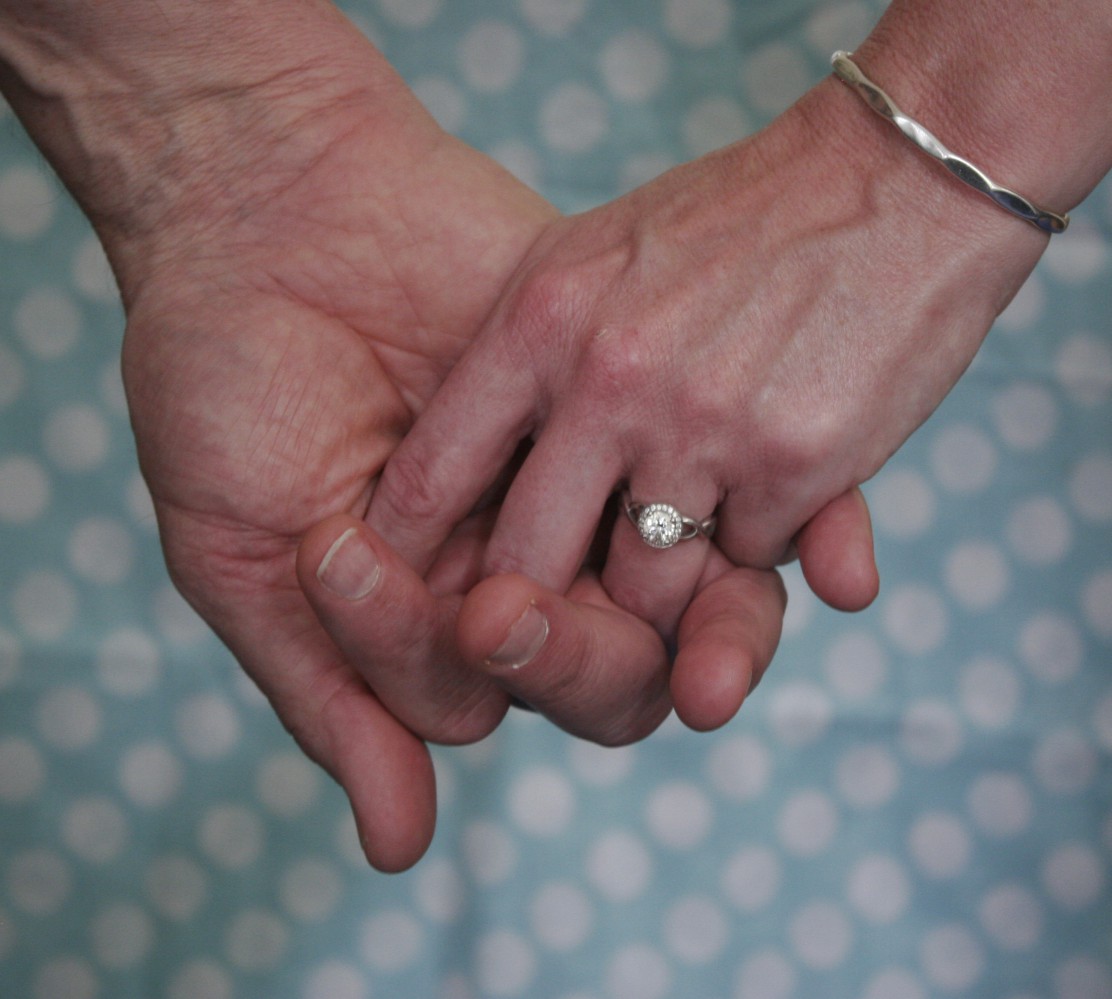
A ring (not unlike a relationship…hmm) calls forth all kinds of expectations: deeply, sometimes even subconsciously, held ideas about how something should look or feel or be, how others should act or respond. The “unexpected” expectations are particularly tricky, since most of us don’t even realize we hold them until something we didn’t expect happens instead.
For example, I didn’t realize how much I was looking forward to people asking to see my ring until a lot of folks didn’t. I suspect people refrain out of politeness: they don’t want their natural curiosity to be confused with nosiness (or judging the rock). I was equally hesitant to thrust my hand out uninvited, lest my excitement be misinterpreted as showing off or demanding admiration. But I quickly realized I had indeed expected most everyone to respond to my news the way the women in my office did: all three stood up, crowded around me, gave me congratulatory hugs, and then took my hand and gasped. Such moments were part of the dream for me, and I thrilled to the, well, thrill of it all. After all this time, announcing I was engaged did feel kind of miraculous.
This is my “It’s a miracle!” face.
I love my ring and the story it tells me. I chose it myself, sort of, and it’s the “sort of” piece that makes me cherish it all the more. The story of that “sort of” is itself a parable about expectations.
Over drinks with Steve late one December night at Billy’s, the specter of marriage arose, and he hinted he’d want to know, at some point, what kind of ring I liked. I’ve always loved vintage clothes and jewelry, and some years ago at an antique show, I’d tried on and fallen hard for a filigree band set with a small diamond. Based on that, I told Steve I liked art deco styles. Later, it occurred to me that the filigree piece was the only diamond ring I’d ever given more than a passing glance. I had no idea what I liked. Continue reading →
So, after someone asks, “After all these years, how did you know?” you focus first on the “how did you know” piece. After the third or eighth or seventeenth sales clerk/prospective vendor/random person in public sees your forty-something self with wedding-related items and assumes you are the mother of the bride instead of the bride-to-be, you start thinking more about the “after all these years” piece.
Is it possible to laugh out loud while grimacing in rueful recognition? Ladies and gentlemen, Garfunkel and Oates, in “29/31”:
Lest you’re wondering, no, I’m not 29-and-holding; in fact, I’m quite a few orbits past 31-and-kvetching. (Well, okay. I cop to the kvetching.) Actually, it amuses and bemuses me every time I hear a news story about how the average age of marriage has risen dramatically in the past few years. To 27. Of course, that is an average. Just doing my small part to blow the curve.
I don’t know that I ever felt as confident and glib as “29,” though I definitely shared her naivete–especially the bit about how love and partnership “just happen.” I didn’t hit “31’s” wall of angst until I turned 36. Forty was closer than thirty…when did that happen? Suddenly I saw with clarity how the trajectory of my life, in terms of readily available dating opportunities, had progressively and steadily narrowed: the wide-open spaces of college in a big city when most everyone my age was unmarried and so “available”; grad school in a slightly smaller city, where the increasing demands of school and teaching meant I mostly met men in my department, a good third of whom were already attached; then my first full-time job, even more demanding, at a small college in a tiny Georgia mountain town with a charming square, great festivals, and six eligible bachelors. Okay, maybe seven.
The year I celebrated the pivotal 36th birthday, I’d moved to Virginia and broken off a relationship that distance proved to be a mismatch. Over the next five years I had two revelations: (a) If I wanted to meet people (not just potential partners, but anyone outside work) and see the world, there was no time for or sense in waiting; I was going to have to go against my introverted grain and, to quote a mentor, “make my own luck.” And (b) it was entirely possible that despite whatever efforts I made or adventures I embraced, I wouldn’t find a lifetime partner (unless felines counted). And whether I did or not, I was going to be okay.
More than okay, actually. I was going to be awesome, because I could choose to live an awesome life, whether I lived it alone or with a partner. Or alone or with a partner with cats.
Not long ago, NPR ran a great piece on Morning Edition I wish I could have heard many years ago: “For Single Women, ‘An Infinite Variety of Paths’.” The piece ran as part of their current series on “The Changing Lives of Women,” and focused on an interview with Rebecca Traister, author of Big Girls Don’t Cry. My favorite comments from Traister’s interview are those the title is drawn from: “…we make a mistake when we create a binary between, you’re either married or you’re unmarried. Once you lift the imperative that everybody get married at age 22, what you get is an infinite variety of paths. It’s not simply some argument that single life is inherently better than married life. The fact is there are all kinds of married lives and all kinds of single lives, and more people are now free to go down a variety of paths.”
“An infinite variety of paths.” Which may be walked (or strolled, or skipped, or stampeded down) at an infinite variety of ages. Remaining single at 31, or 36 (or 43 or 55 or or or) doesn’t mean life is “over”; getting married at any age is simply the start of another exciting (and, for me, as yet uncharted) path. Not all who wander, as they say, are lost, and if we’re lucky, we’ll have the chance to experience many different paths within one lifetime, each with its own challenges, riches, and joys.
Some of them have annoying sales clerks. But some of them have cats.
A month or two after Steve and I got engaged, I had lunch with a friend and former colleague, Thomas. Thomas and I go back almost fifteen years, having met the day I started my first full-time faculty position. He and I had both joined the Language and Literature department of a small state university in Georgia in the fall of 2000, I as an assistant professor fresh out of grad school, he as the new department head established in his academic career. He became a valued mentor as we bonded over our shared status as newbies to the college. We’d left Georgia at the same time, as well, when he and his wife Anne Marie moved to Switzerland, where he’d accepted a professorship, the year I moved to Virginia.
We’ve stayed in touch and have found opportunities for the occasional reunion, the last a family holiday gathering in 2011. When Thomas emailed he would be stateside and passing through my stomping grounds in June, I made plans to meet him. Over sandwiches at Panera, he caught me up on his new book and Anne Marie’s library and translation work, and I filled him in on my memoir-in-progress and my engagement to Steve.
Then, Thomas asked me a really interesting question.
“So,” he said, setting his cup on the table and peering at me through wire-rimmed glasses. “I have to ask. After all these years, how did you know?”
“That’s Steve’s the one?” I said. Thomas nodded.
The cynic in me was tempted to reply, because he asked, and no one else ever did. But that wasn’t entirely true, and it wasn’t the real answer to the question, anyway. “Well,” I said. “I guess the first thing that comes to mind is—because of how he treats me. He’s a genuinely good man, and he’s good to me, and it’s…well, it’s easy.”
Thomas gave a nod of recognition and smiled.
“It’s funny,” I continued, “because all these years, people have been telling me things like, when it’s the right one, you’ll know. It will be easy. And I would sort of nod along, yeah, sure.” I sipped my tea. “But I think that’s true. It is easy. Not in the sense that there aren’t complexities. But there is a sense of ease, of rightness. There’s an effortlessness to being together.”
My dad Garry, professor turned beekeeper
Thomas nodded more vigorously and said, “Yes. Yes, that’s good.”
“And then there’s this other piece that’s going to sound kind of weird,” I said. “Sometimes it seems a little weird to me, anyway.”
Thomas raised his eyebrows.
“Well,” I said, “Steve is the man most like my father of any man I’ve ever dated.”
At that, Thomas burst out laughing. But he kept nodding.
I’ve taken to calling the look or design of our wedding, as I envision it, “Vintage Whimsical.” Steve said I’m probably the only person on the planet who knows what I mean by that, and I suspect he’s right. 🙂 The centerpiece idea here may offer one illustration.
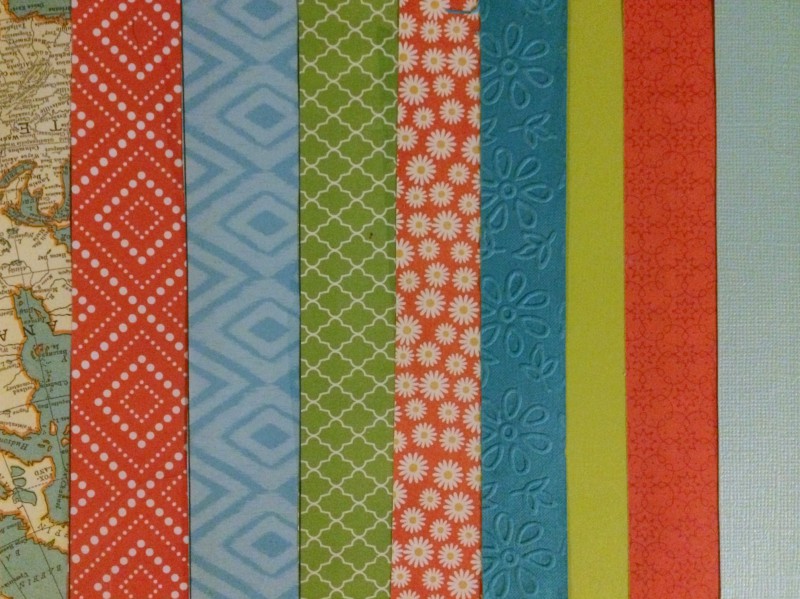
My creativity tends to be object-inspired: when I see a fabric or dish or some other design element that appeals to me, I start putting it together in my mind with other colors and objects. So, once I found the aqua bottles and the fabric–a wonderful combination of bright, modern colors with a lacy, romantic design–the tabletop decorations pretty much composed themselves. Though they may undergo some tweaks in the coming months, the photos capture the initial idea.
A week after my bookstore visit, I had chosen my wedding colors.
In my defense, my headlong plunge into planning wasn’t entirely a result of my inability to resist the wedding industry’s wooing—though it’s a persistent suitor. When you’re a bride-to-be, the special offers start coming your way, and fast: coupons and websites and bride bags, sweepstakes open only to the betrothed. The steady stream of messages proclaiming your special status is seductive, but the truth is that the most special thing about you in the eyes of the industry is that you and your family are preparing to drop some dough. All those folks fawning over your bride-ness are hoping that (a) it’s a lot of dough, and (b) you’ll send it their way.
It’s sometimes irritated me, actually, that we féte brides and grooms with such fervor, while we all but ignore many milestone accomplishments that result from flat-out hard work. The happy couple, after all, has already won the lottery of luck and timing, so why do they get the cake too—not to mention the complimentary tasting? Follow the money, though, and there’s no market for grandly celebrating something like, say, earning an advanced degree. Most grad students live on the edge of poverty, and mass graduation ceremonies—usually long and boring and involving uncomfortable chairs—are a much harder sell than a garden party with free booze and a DJ.
But I digress. 🙂
I was excited about our engagement, of course, and in love, and all those long-tamped down and tossed aside dreams from my girlhood rapidly re-surfaced. That’s the state in which the wedding industry can have you at hello, the danger zone wherein they can talk you into moneymakers masquerading as must-have traditions, whip you into a frenzy of wants disguised as needs. Caution is well advised.
For me, though, the industry, with all its wiles, wasn’t the greatest source of temptation. Continue reading →
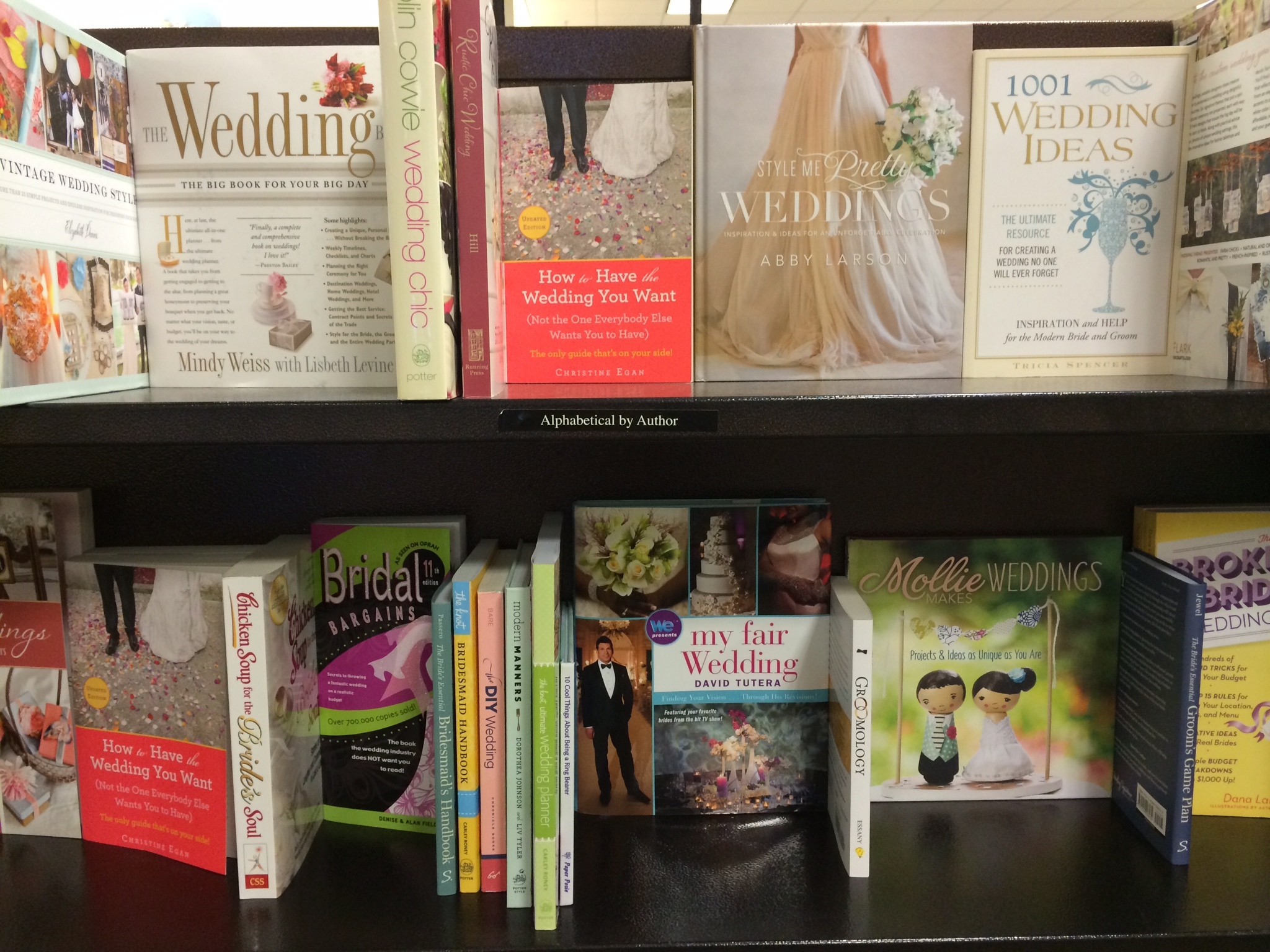
Within two days of arriving home after our Virginia Beach engagement, I found myself standing in Barnes and Noble, staring at shelf upon shelf of books for brides-to-be.
There were planners and checklists, do-it-yourself decorating tips, weddings-on-a-budget books; thick binders and skinny hardbacks and sleek spiral-bound volumes of all shapes and sizes (weirdly, a bit uniformly pink in hue–really, are we twelve?). All claimed they’d help me plan the wedding of my dreams. And I hadn’t even gotten to the magazine section, where a row of strangely serious, sculpted women, all angled elbows and white lace, brooded out at me from the covers of at least ten different glossy tomes.


 Forty-Something First Time Bride