Image

Why the best wedding day won’t be the best day of your life

Whenever bridal magazines or wedding dress ads proclaim my wedding day will be the most wonderful day of my life, I hope they’re lying.

Think about it. You find the love of your life, decide to get hitched, throw a big party to celebrate the beginning of your marital bliss, and—what? It’s all supposed to be downhill from there?

Lies, damned lies…and some statistics

Putting all the emphasis on the big day may well start a marriage off at a disadvantage. According to a study conducted by economists Andrew Francis and Hugh Mialon of Emory University, there is a negative correlation between lavish, high-cost weddings and how long a marriage lasts. “’A Diamond is Forever’ and Other Fairy Tales: The Relationship Between Wedding Expenses and Marriage Duration” made a big media splash in fall 2014.The authors surveyed over 3000 adults, all of whom had been or were still married. They discovered that “relatively high” spending on an engagement ring increased the odds of the marriage ending early by 1.3, and those adults who reported spending more than $20000 on their wedding were 3.5 times more likely to get divorced than those who spent between $5000 and $10000.

Overall, those who spent less on the wedding tended to stay married longer. The researchers speculated that marital stress caused by debt was a contributing factor. Couples do fight about money, but in many cases, parents pay the wedding bills. Still, the considerable gap between the world of extravagant weddings and everyday life creates unrealistic expectations, and too often, the nuptials command more devotion than the actual relationship.

The problem is that we still believe in fairy tales. We plan a wedding but act as if a marriage just happens.

“Downhill” is relative

A wedding is not representative of married life. Yes, it’s a wildly exciting day, filled with the love and affection of visiting family, hours of talking and dancing with friends, beautiful flowers, fancy cake. It’s a day full of meaning and ritual, public declarations of deep feelings (and, not incidentally, a significant outlay of cash). Every moment matters, every detail is documented.

So there is an inevitable post-wedding lull, maybe even a bit of a letdown.

Thank god.

Supposing I could survive an entire married life so physically, emotionally, and financially intense, if nuptials actually modeled marriage, I would still implode under the pressure of wearing white every day.

Planning a wedding together, on the other hand, is excellent practice for marriage, and, I suspect, much more representative of daily married life. Planning together requires teamwork, communication, negotiation. My fiancé Steve and I have volleyed ideas back and forth, discussed preferences, revealed our individual likes and dislikes. We’re learning, together, how to balance desire against budget, what to prioritize, where to save and when to splurge. We’re making mutual decisions and sharing burdens, discovering more about ourselves and our partnership. We’re growing our love for one another as we look forward to the future, together.

Maybe that sounds less than romantic, but love that lasts is built and sustained through the daily choice to stay present and engaged. Love is something you do as much as feel. According to Carrie Ichikawa Jenkins, a philosopher who studies romantic love at the University of British Columbia, instead of buying into pre-determined ideas about romantic love as a “package deal” complete with “hearts and flowers” and “eternity,” we need to ask “what is love?” and define and shape it for ourselves. We need to do the same for marriage. Crafting a marriage that lasts requires deliberation and conscious reflection; it takes, as Arthur C. Brooks urged in a recent NY Times column, courage and mindfulness. A loving, committed marriage doesn’t just happen; even more so than a wedding, it demands thought, time, investment.

Parents of brides (and grooms) to be, take note. Traditionally, when parents foot the bill for the wedding, they maintain control of the budget and command a greater say in the decision-making. You might have paid for your child’s college, too, but did you dictate every class taken, every club joined, the chosen major, minor, and concentration? (If you did, you might consider paying for your kid’s therapy before taking on a wedding—just sayin’.) Giving your child a fairy tale wedding and worrying over every last detail of it yourself deprives your child and his or her partner the opportunity to learn to work as a team, the chance to begin learning how to budget, prioritize, negotiate. It robs them of the opportunity to reflect on what they value as a couple, to learn more about what makes their future spouse tick (or tic). Given the stats, less fairy tale and more participation from the bride and groom might be a better option.

Besides, having the support of family and friends matters more than their readiness to pay for an extravagant event; Francis and Mialon’s study showed positive correlations between marriage duration and higher numbers of people attending the wedding. Couples who went on a honeymoon were also more likely to create a lasting marriage, perhaps buoyed by their willingness to invest dedicated time in new experiences and one another.

Don’t forget the map

The wedding is the exotic island getaway: a weekend of high upon high, a romantic and sensual blitz. Marriage is a cross-country road-trip. There will be days of high adventure and exquisite beauty, days that rise above others in their pleasure and joy: watching a child walk confidently across the swinging bridge he once feared, standing sweaty and spent with your spouse atop a mountain you’d long dreamed of climbing together, dancing in the light of a fading sunset on the beach where you first fell in love. There will be days, should the fates allow, even more wonderful and wondrous than the day you walked down the aisle.

But there will be steep descents, too, and wide, flat plains of calm. With any luck, you’ll mostly travel through rolling hills and gently scenic vistas, the occasional dramatic peak rising up and surprising you, the stunning, startling beauty of a tree pushing through rock. Some days you’ll pass through valleys drizzled in rain or buried in snow; others you’ll walk the windswept dunes of sun-warmed beaches, the ocean lapping at your feet. There will be exhilaration, exhaustion, exertion, and rest.

Always, the horizon will stretch before you to a future beyond imagination. May the map of your love be your guide.

Image

Invitation: Traditional-Fairy-Tale-Takedown Challenge

As Valentine’s Day approaches, it’s almost impossible to escape the standard romantic narrative that presumes we all aspire to march two-by-two into happy (and usually heterosexual) committed couple-dom. But so many of us whose feet don’t fit the standard glass slipper are living amazing lives we love, and those stories need to be told, too!

Your challenge: write your own alternative fairy tale, one that describes your current awesome life or hints at the fairy tale life to which you aspire.

Guidelines:

  • Your fairy tale should open with (what else?) “Once upon a time” and be 6 to 7 lines long, loosely following the models of the “world’s shortest fairy tale” and other examples, below. Unconventional tales most welcome, but more conventional ones are too, if that’s your happy place. No need to include a proposal, unless it’s part of your story.
  • The challenge remains open from February 10th-20th; post and link or submit within that window.
  • To participate, post your fairy tale on your own blog and link it back to this post, post it in a comment below, or send it directly to me at 40somethingfirsttimebride@gmail.com.
  •  All entries PG, please. 🙂
  • Tag #fairytaletakedown if you wish (I’m still kinda figuring the hashtag thing out.)

In early March, I’ll feature some of my and my readers’ favorite fairy tales in a follow-up post. Please visit the blogs of those who submit, and like and comment on your faves! Any non-bloggers, indicate how you’d like to be identified in the post should your fairy tale be included in the March feature.

The inspiration for the challenge

Back in October, I questioned the privileging of a single model for happily ever after, and its counterpart as featured in the following meme:

fairytalememe3

You can read the original full post here, but here’s what I had to say (with a few updates) that’s relevant to this challenge:

“The meme made me laugh—and think. It works specifically because we’re familiar with its counterpart, the fairy tale wherein the girl says “yes,” they marry, and presumably live happily ever after. In the male version, the “happily ever after” is spelled out in detail, though in traditional fairy tales it’s not. The conventional version, if it were spelled out, might look like this:

Once upon a time, a man asked a woman, “Will you marry me?”
The woman said, YES! And they lived happily ever after
and settled into a lovely house with a big yard
and had one boy and one girl and a well-trained dog
and the man made lots of money while she cooked perfect dinners
and they held hands every day until the day they died.

Of course, even for women who desire marriage or partnership, not everyone’s happily ever after includes 2.5 kids and a mortgage. The assumption that marriage per se is every woman’s dream—the assumption the original meme’s humor depends upon—is, if not sexist, at least shortsighted. A good marriage built on true companionship is something I want (even though it scares me in some ways). But I resist the easy equation of single male = happy and married female = happy as a default setting; it seems especially problematic in a world where not everyone has the legal right to marry even when they wish to. There are alternatives to both of the above tales. My  own life, prior to Steve’s presence in it, looked a bit like this (yes, I was proposed to once before, but that’s a story for another day):

Once upon a time, a man asked a woman, “Will you marry me?”
The woman said, NO!  And she lived happily ever after
and moved to Virginia and traveled at every opportunity
read incredible books and drank good wine and tea
and spent money on journals, artwork, and clothes
had a raspberry-pink sofa and loved her four cats
and farted whenever she wanted.

The last line is not a typo. You think women who live alone don’t enjoy the freedom to fart with abandon (or put off shaving, or let the dishes pile up in the sink…)? Now, there’s a fairy tale.

Here’s another, a composite fairy tale based on some awesome women I know:

Once upon a time, a man asked a woman, “Will you marry me?”
The woman said, NO! And she lived happily ever after
and traveled to Africa and met fascinating people
took up running and drank cosmos and craft beer
and spent money on marathons and beautiful shoes
bought a sewing machine and fostered rescue dogs
and (just guessing here, friends) farted whenever she wanted.

The upshot? One person’s sweetened-up Disney fairy tale is another person’s gloomy Brothers Grimm version. And (this is not news): there is no “happily ever after,” at least none that applies universally—nor, I would hazard, only one that is possible in any one person’s life. I wrote about the “infinite variety of paths” we might travel as we wind our way through the world, and, for each of us, I believe, there is more than one route to happiness. Mine is starting to look a little something like this:

Once upon a time, a man asked a woman, “Will you marry me?”
The woman said, YES! And they lived happily ever after
and traveled together to oceans and mountains
and talked and read books and gave each other plenty of space
and spent money on wedding stuff and shopped for a house
and wondered when to introduce her cats to his dog
who farted whenever he wanted.”


Submit your alternative fairy tales!

Image

How to Speak Flower

The language of flowers, known as floriography, has been spoken for centuries: Shakespeare made use of it in numerous of his plays, as did Jane Austen in her novels. The practice of sending “secret” messages through flowers became extremely fashionable in Victorian times, when it was considered gauche and inappropriate to speak openly about one’s affections. It’s hard to imagine that the messages contained in these “tussie-mussies” (small bouquets wrapped in lace and tied with ribbon) remained secret, given the wide popularity of flower dictionaries that helped senders and receivers compose and translate. Many of the meanings we associate with particular flowers today descend from these Victorian-era dictionaries, some of which, like Kate Greenaway’s 1884 The Language of Flowers, remain in print.

Not all guides offer the same translations, though there’s some agreement. Roses have long been associated with love, but other flowers also indicate romantic affection. Tulips express love, although the giver needs to choose the color carefully: red tulips say perfect love and commitment, while yellow tulips have traditionally signaled hopeless love. For the true romantic, Greenaway’s flower dictionary notes that variegated tulips tell the recipient she (or he) is possessed of “beautiful eyes.” Daffodils convey regard or, even more pleasantly, “the sun shines when I am with you.” Ivy is associated with fidelity and marriage, while peonies suggest early love and bashfulness. Orchids indicate rare beauty. And for all the sapiosexuals out there, pansies are for “thoughts” and clematis indicates “mental beauty.”

February is the month for flower-speak, which piqued my curiosity: what stories might some of the flowers we’ve selected for the wedding tell? Continue reading

Image

When Love Means Letting Go

for Eliza Jane 2002-2015

I have a blog calendar, and I typically plan my posts, or at least my topics, well in advance. I’ve had the “cats and weddings” topic from Tuesday on the calendar for at least several months (you can actually see the post-it on the calendar in “(Not Too) Much A-Do About Being”), even though I wasn’t sure exactly what direction the post would take until I worked it up last week. The timing, as it turns out, was either terribly perfect or perfectly terrible, because today, I lost my beautiful Eliza Jane.

I’d planned to write about something else for today’s post. And I cannot, at this juncture, be anything approaching eloquent on the subject of her loss. But to post about anything else feels disingenuous, and she taught me so much about love and life that writing seems the best way to honor her.

My Liza

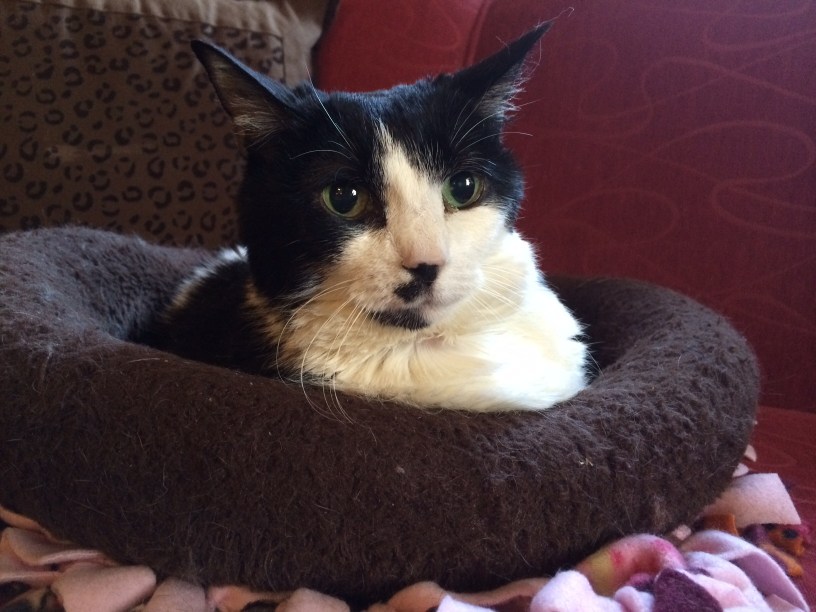
Eliza Jane is the only cat I raised from a kitten. She came to me under coercion: a stray calico took up residence in my parents’ storage shed and gave birth to a litter. Eliza was the only black-and-white kitten, and I already had tuxedo cat Roscoe. My mother informed me Roscoe needed a friend, so the Holstein kitten with the half-mustache and perpetually startled expression would be mine.

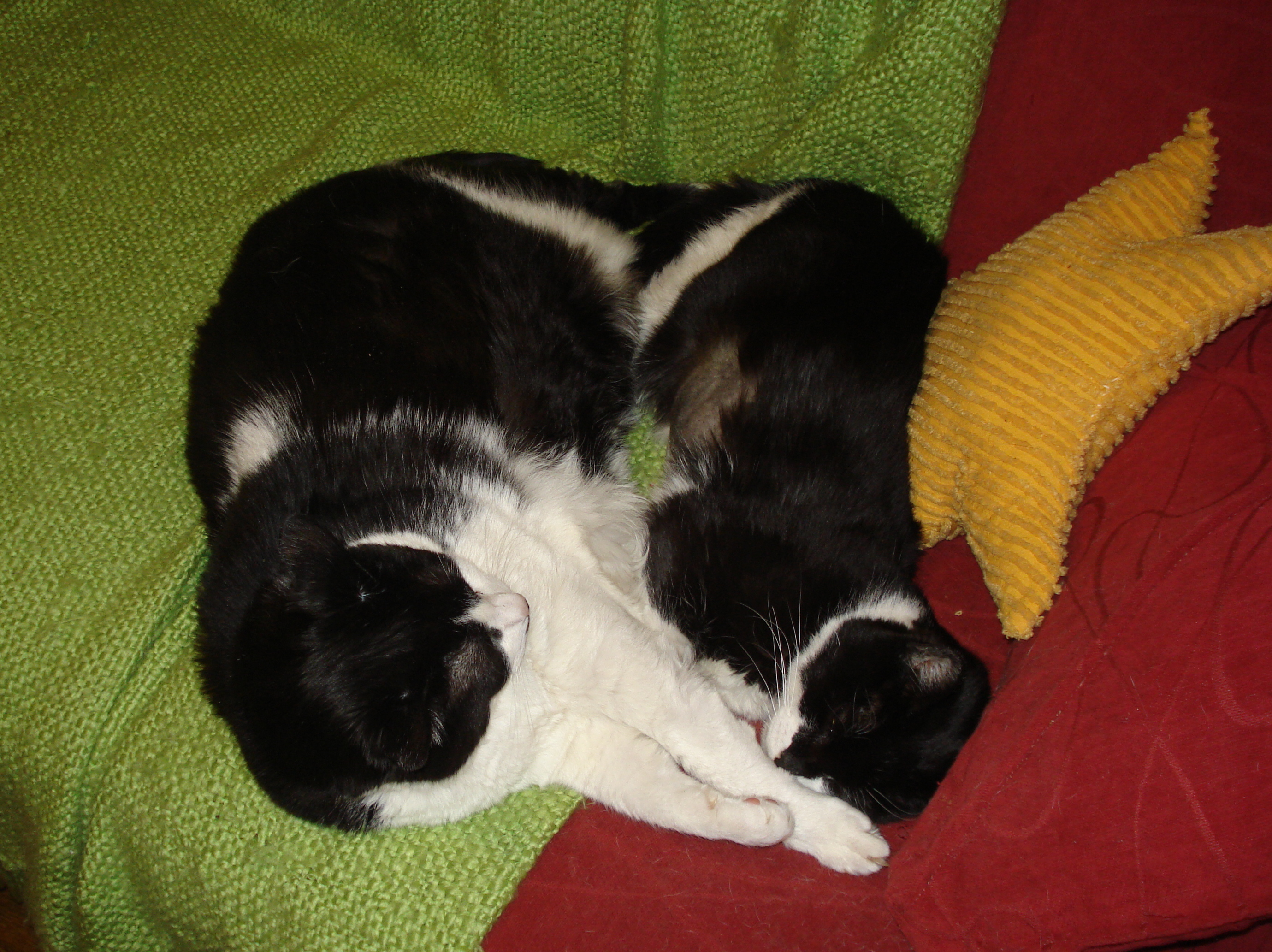
Eliza snuggling Roscoe after a biopsy in 2009

Eliza snuggling Roscoe after a biopsy in 2009

Roscoe adapted pretty quickly. Eliza loved to snuggle with him, even after she grew too big for both of them to fit comfortably in one bed. As a tiny kitten she would hang out on my shoulder for short stretches, but she was never much for being held. She’d sit next to me, on rare occasions in my lap, but she was always more aloof and independent than her big brother. And feisty—she earned herself a star on her chart at the vet, and it was not for good behavior.

Eliza was the only cat I’ve ever known who played fetch. It was almost unbearably cute to watch after my mom bought her a kitty toy football. Touchdown! Continue reading

Image

On Cats and Weddings

A day or two ago, a post about CatCon LA showed up in my Facebook newsfeed. Sporting the tagline “It’s like Comic-Con…but for cat people,” CatCon LA is “part expo, part symposium,” and will, according to its website, feature “the world’s top cat-centric merchandise including furniture, art, toys and clothing for those of us who possess a great love of the feline.” There will also be speakers, including Simon Tofield, the creator of the brilliant Simon’s Cat animated cartoons. I’ve never really understood the appeal of Comic-Con, but CatCon kinda makes me wish Los Angeles weren’t so far away.

Go ahead, roll your eyes.

One of the unexpected benefits of being engaged: I can embrace my love of felines without fear of being labeled and dismissed as a stereotype: the single middle-aged crazy cat lady.

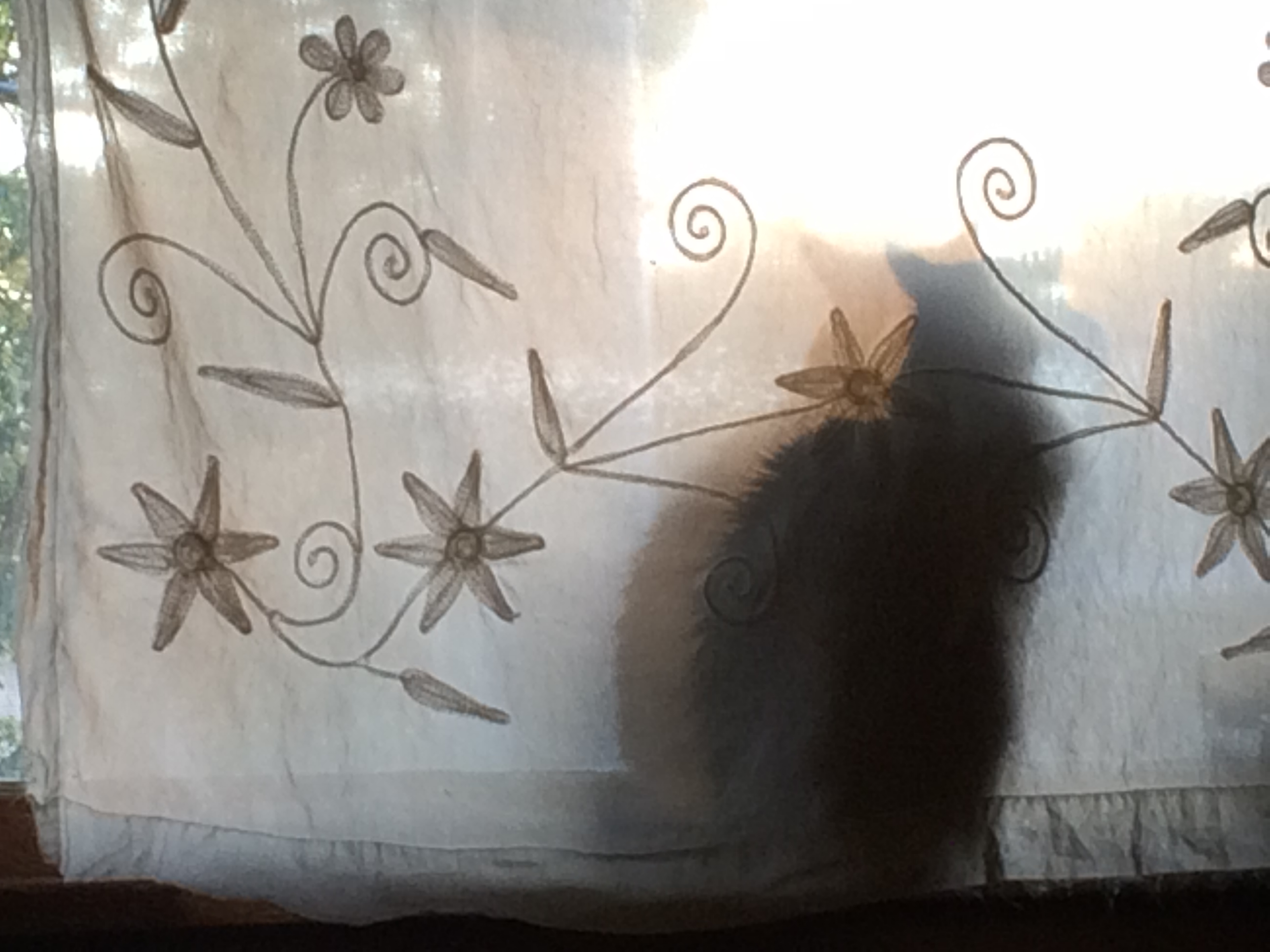
Charlie in the window

Charlie in the window

I’ll just be a married middle-aged crazy cat lady.

For the record, there is nothing wrong with being a cat lady, or a cat person, single or married, crazy or crazier. Though I confess: I cringe whenever I find myself at the grocery checkout, buying a stash of microwaveable meals, a couple bottles of wine, and 20 cans of cat food. Add chocolate, I’m a walking cliché.

And yet: my cats are really the only creatures who’ve been my constant companions, day in and day out, greeting me every morning, welcoming me at the door every night. I have wonderful friends and human family I love dearly, but none of them wakes me up purring with a chin resting on my pillow, or perches in the front window, anxiously awaiting my arrival home. Continue reading

Image

Bratty Bride Goes Shopping

If “Bridezilla” and some of the other wedding reality TV shows are to be believed (and I’m not so sure they are—no bride I’ve known has had anything so much as resembling a meltdown), there are at least a few ladies who think their “bride” status entitles them to be bossy, demanding, and downright rude. Planning a wedding can be stressful and time-consuming, but whenever I get the urge to complain, I try to stop and remind myself of one key thing: every last piece of it is a privilege.

It’s a privilege to have found a partner who returns my love and shares a desire to commit to a life together. It’s a privilege to have caring family and friends with whom to celebrate our joy. And it’s privilege to have the resources to throw a party with beautiful decorations and  abundant food and drink. These are not things to be taken for granted, and they’re assuredly not a license for temper tantrums and testy outbursts.

So I’m confident “Bridezilla” is well beyond my basic crankiness capabilities.

I’m embarrassed to admit that a little alter-ego I’ve come to call Bratty Bride is not.

 Meeting Bratty Bride

When you’re planning a wedding, everyone, it seems, has an opinion. Vendors and wedding professionals—the photographer, the florist, the DJ—are supposed to have opinions; you pay them well for their expertise, and when they share their knowledge, it impacts your vision and helps you make decisions. But then there are, oh, say, the overly enthusiastic dental hygienists, or the nosy sale clerks whose advice seems entirely derived of their own nuptial dreams and utterly divorced from the reality of yours.

It was whilst I was on the receiving end of such advice that I first met my inner Bratty Bride. Continue reading