Image

Green Gifts and a Few Other Favor-ite Things

A friend recently shared a link to a New York Times article about the amount of plastic accumulating in our oceans. She captioned it with a plea: “Before you buy all those plastic toys and stocking stuffers for Christmas, please consider where it will end up once they’re thrown away.” The accompanying photo was horrifying: a pile of plastic debris on a beach in Portugal, so thick it obscured the rocky shore underneath.

The photo, and my friend’s request, resonated in light of—of all things—our search for personal, useful, and earth-friendly wedding favors. Wedding magazines offer an abundance of what folk musician Nancy Griffith once referred to as “unnecessary plastic objects”: giant “diamond” key-chains, wedding-cake shaped candles, nesting hearts salt and pepper shakers. All sweet to look at, but—let’s be honest—likely to end up in the landfill. Traditionally, favors were foodstuffs, and something simple and edible like Jordan almonds or truffles seems much more earth-friendly than miniature Lucite chairs. That is, until you dress the truffles up in multi-layered packaging, little brown boxes with raffia ties and tags, or festive cones in cardboard stands. So cute! And sadly, sure to be tossed as trash as soon as the guest has enjoyed the treat within.

Some thoughts on the thought that counts

Though I’m not so keen on unity sand, I like the tradition of wedding favors, maybe because I’ve always loved choosing (or making) just the right gift for someone, whether it’s big or small, silly or sweet. My relationship to gifts has changed a little in recent years, however, in concert with my shifting relationship to “stuff.” I’ve become increasingly aware of the costs, both to our planet and to our psyches, of an excess of objects cluttering our minds and homes, our waters and our world. Continue reading
Image

DIY Decor: Vintage Finds Cakestand

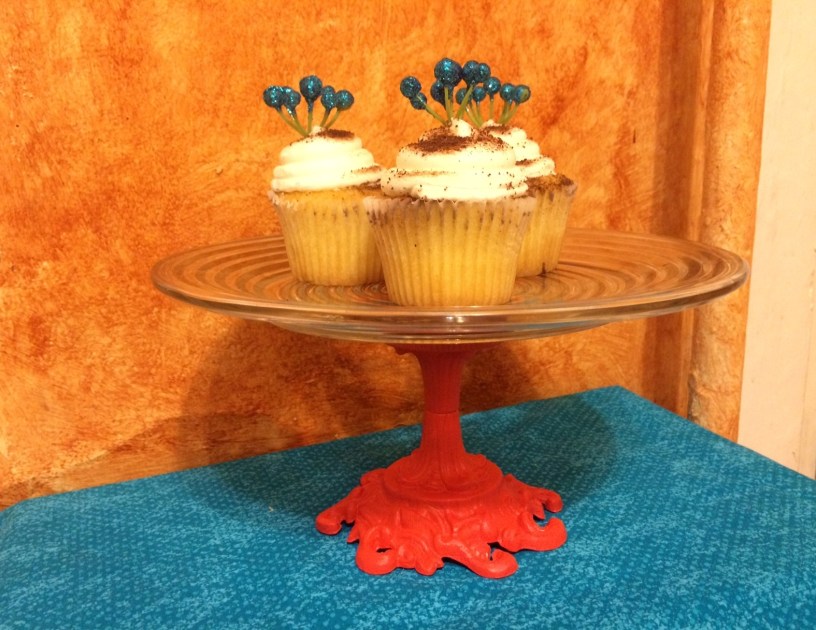
This is a quick and simple project, and a great way to create a unique pedestal cakestand that will (ahem) “elevate” your wedding (or holiday) pies, cakes, or cookies!

A few weeks ago in “Perfectly Imperfect,” I shared some of the thrift store finds I’m re-habbing to use as part of our wedding decor. First up, turning mystery object #7 and plate #2 into a cakestand with character. For those of you (still) wondering: mystery object #7 is a vintage toothbrush holder! It was obviously in need of a coat of paint, so I selected Valspar Signature, satin finish, in “Trolley” to coordinate with our wedding colors. (Note: A lot of hardware and home stores now mix and sell half-pint sample sizes, which makes it easy to purchase just the right color for a small project.) Continue reading

Image

Breaking Cake Together

Once we had a venue selected and booked, it was time to turn toward securing other vendors. The choice of where to focus next was obvious: the cake.

It’s all about priorities, people.

The tradition of wedding cakes, according to a fascinating history by Carol Wilson in Gastronomica, dates back to antiquity: “Ancient Roman wedding ceremonies were finalized by breaking a cake of wheat or barley…over the bride’s head as a symbol of good fortune,” after which the bride and groom would share a few of the crumbs. I’m certain many brides were grateful when this custom (also the precursor to modern-day confetti, says Wilson) morphed into a somewhat gentler crumbling of the cake over the head. Still, both rituals are a little too similar to the disturbing contemporary trend of the bride and groom shoving wedding cake in each others’ faces. Because nothing says I love you like frosting ground up your nose.

I’m equally glad we’ve moved beyond Yorkshire’s “Bride pie” (1500s-1800s), which Wilson describes as consisting of “a large round pie containing a plump hen full of eggs, surrounded by minced meats, fruits, and nuts” and decorated with “ornate pastry emblems.” It sounds like a cross between a Turducken and a fruitcake, and the fertility symbolism is a little less than subtle. According to Wilson’s history, it wasn’t until the late 1700s that a sweet cake finished with white icing became a common part of English wedding celebrations. Continue reading

Image

Steve Speaks: FsSTG meets FsFTB

FsFTB readers: Every so often my fiancé Steve will be chiming in with a post of his own—this is his first! 

Hello. My name is Steve, and I’m a fifty-something second-time groom.

I’m honored but somewhat intimidated to be invited to guest-blog here. I write a lot as a member of the forestry faculty at a state university, but what I write for work is mostly scientific and technical stuff about maps and carbon sequestration. Don’t worry—there won’t be trees or maps in this post! For balance, my forty-something first-time bride, Sandee, has invited me to tell my story, that of the fifty-something second-time groom. With two grown sons. And a dog. So to start: how can I discuss what the “second time” means without acknowledging the first time?

I was married in 1985 to Karen, a forester who worked in South Carolina when I worked in Georgia. We became engaged less than a year after we started dating, and there were fewer than six months between engagement and marriage. Quick, huh? I’d gotten a job offer in Alaska, which meant a compressed schedule for the wedding. We married in March in upstate New York, and our honeymoon consisted of a cross-continent roadtrip in a pickup truck with her golden retriever, followed by a three-day ferry ride from Seattle to Haines, Alaska, and a two-day drive from there to Anchorage. (Sandee and I don’t know yet where we’ll be going for a honeymoon, but let me go on record here as promising it won’t involve a dog and a pickup!)

Karen and I had twenty mostly very happy years together. The last twelve were under a slowly darkening cloud after she was diagnosed with multiple sclerosis. She died in January 2006, closing a chapter in my life and changing the nature of the family that remained: I became a single dad raising two teenaged sons. As it tends to do, time has healed wounds and filtered memories, so that most that remain are the good ones, and I look back on what we had with fondness, love, humor, and gratitude.

Steve&Tucker2

With oldest son Tucker

Fast forward: there’s this house on the end of my street. The yard is not very well kept. Holiday decorations appear only sporadically. Three guys, plus one canine (born male but subsequently modified), live there. Two of the guys are recovering adolescents; the other has gray in his beard as a result. It’s a testosterone-rich, estrogen-deprived zone, and you can tell it by the décor. And the state of the bathrooms. So, who is the guy who owns that house?

Well, I guess that would depend on who you ask. My neighbors see the guy with the unkempt yard. My students see a professor. My sons see a father, and my dog…well, judging by his greeting, I think he sees me as the center of the universe!

As I left my teens and progressed through adulthood, I tended to identify my “self” with the primary role I was playing at the time. I was a flannel-shirt-clad forestry student during college and graduate school. When we moved to Anchorage and our initial friends were all from Karen’s recreation-league soccer team, I became “Karen’s husband.” To those in the forestry company, I was the guy in charge of the number-crunchers in the technical department. When my boys started playing sports and joined scouts, I became identified as “Tucker’s Dad” or “Dusty’s Dad.” Returning to academia as a professor, I was the guy going up for tenure in his forties. Later, I became the guy who lost his wife. Continue reading

Image

Wedding Planning 101: Lessons from Kim and Kanye

I don’t usually follow celebrity gossip, but whenever I visit my hairstylist or the doctor’s office, I enjoy flipping through a cheesy magazine or two. After all, it would be un-American of me not to maintain at least a basic knowledge of the intimate details of vast numbers of people I’ll never meet and rarely respect. While getting my hair done not long ago, I was perusing my stylist’s back-stash of celebrity rags and saw a magazine headline from fall 2013, something along the lines of “Kim leaves wedding planning to Kanye.” Along with most of the rest of the internet, I’ve seen a bit more of Kim Kardashian lately than I ever really needed or wanted to, though truth be told, I only know who she or any of the Kardashians is because their antics get so much press coverage (if coverage is the right word…). Sans cable or satellite, I don’t get E! and have never seen the family’s reality show. In fact, I’m proud to report I had to look up which network even carries it; as further proof of our compatibility, Steve didn’t know either!

The part of the headline that caught my eye was not “Kim” nor “Kanye” (the musician who railed at Taylor Swift for winning a Grammy he thought someone else deserved, yes?). The words I latched onto were, no surprise, “wedding planning.” Steve and I are, relatively speaking, still in the early stages of corralling the vast compendium of activities that innocent-sounding phrase describes, but I continue to feel amazed and overwhelmed at the seemingly infinite reach of this thing called the “wedding industry.”

So, when I read the headline, I had three thoughts, in this order: (1) Wow, there are times when I wish I could hand it all off to Steve. (2) I could never hand it all off to Steve—I’ve waited years to plan my wedding! And finally, (3): Bullshit. Kanye’s idea of wedding planning probably means making a list of extravagant ideas, picking up a phone to hire a wedding planner, and then telling his staff to get busy. Methinks–as I have texted back and forth with my mom about fabric choices, spent hours perusing photographers’ websites, and sent yet another email to our chosen venue, asking, again, when can we, please, sign a contract?—Mr. West’s dreaming up ever more grandiose ideas with nary a worry of how to finance any of them does not count as “planning.”

Continue reading

Image

A Mother’s Dream, in honor of the wedding that wasn’t

As a child and young woman, I attended a Presbyterian church in Georgia where my parents are still members. The current church was built in 1976, when I was six, and I recall the blend of curiosity and awe I felt upon seeing it for the first time: its massive stone walls, soaring wooden beams, the rich red upholstery in the sanctuary. The stained glass windows, an artist’s and writer’s dream, appeared at first glance to be abstract collages of color, but a closer look revealed images, stories, a narrative that traveled from pane to pane. And I was fascinated with the bride’s room, a small, quiet space adjacent to the ladies room off the narthex. Its lime green, high-pile carpet and counter-long mirror framed by marquee-style bulbs made it glamorous and exotic, and I liked to sit on the swirly brass vanity chair and imagine.

One of the most beautiful features of the new church (now 38 years old) was a central courtyard. It is best viewed from the narthex, adjacent to the sanctuary, as the wall between the narthex and the courtyard is made mostly of glass. My mother Margaret has always loved the courtyard, and for as long as I can remember, she has voiced her dream that I would get married there someday. We would stand in the narthex, side by side, imagining the scene together. Guests would enter from the narthex and take seats in white chairs lined up in the central grassy area, shaded by several trees. The groom and minister would enter from the door off the church library, to the left. The bride would enter from the choir room door on the far right, behind the guests, then walk the along the curved, pebbled walkway in front of them to meet her groom. Flowers would bloom all around, the sun light the ceremony. It would be intimate and beautiful.

For years that was the plan, that I would get married in the courtyard. We talked about it enough that I can still picture the walk clearly in my mind. But the years passed, and I remained single. I moved away, first to Ohio, later to Virginia, and I still remained single. The church was expanded and renovated, a fountain placed in the courtyard, and it began to look like I’d always be single. And the years flowed on: I was no longer a member of the church, the minister I’d grown up with retired. When my mother and I had stood at the window dreaming, it had never occurred to either of us that a wedding wasn’t a sure thing. Continue reading