Image

Romance Counts

My fiancé Steve and I see the world differently. He likes to tell the story of how, when we were trying to remember whose toothbrush was whose, he determined ownership by recalling his brush was on the left, mine on the right, whereas I identified our respective implements by color: his green, mine blue. A similar scenario occurred trying to recall which mug belonged to whom—I checked the colors of the teabag tags, remembering Earl Grey was yellow, English Breakfast red, while he’d noted he’d placed his mug to the left. He relies on spatial relationships for identification and cueing. I inevitably register color first.

Colorful blooms caught my eye at the Grove Park Inn

Colorful blooms caught my eye at Grove Park Inn

The point here isn’t that we middle-aged folk keep forgetting things; the point is the differences in how our brains work. Steve has a mathematical, map-guy mind that tends toward a linear, laser-point focus; I’m a creative, crafty type, with a heightened aesthetic awareness, my attentions more diffuse. More than once while traveling, we’ve passed some wacky, hard-to-miss building or sign, or a group of deer hovering on the side of the highway. Each time, Steve was so focused on the road in front of him that he missed anything not represented on the GPS. (Note: generally speaking, a driver’s ability to keep eyes on the road is a plus!) And of course, there’s shopping: if Steve’s targeting shirts, he looks at shirts, and nothing else registers. I am almost incapable of filtering out all the pretty items on the periphery, especially those in my favorite colors.

Our minds clearly process information in wildly different ways, and while this is true for all couples to some degree, our obvious disparity carries the distinct benefit of preventing romantic relationship pitfall #11: believing that true love creates magical mind-reading powers.

To whit: we don’t even see our toothbrushes the same way. Any expectation that the other could consistently and accurately conjure up (and then fulfill) our deepest thoughts and desires borders on absurdity.

But it’s good intel. Because that knowledge reinforces the importance of romantic relationship lesson #23: you have to ask for what you want. Continue reading

Image

Green Gifts and a Few Other Favor-ite Things

A friend recently shared a link to a New York Times article about the amount of plastic accumulating in our oceans. She captioned it with a plea: “Before you buy all those plastic toys and stocking stuffers for Christmas, please consider where it will end up once they’re thrown away.” The accompanying photo was horrifying: a pile of plastic debris on a beach in Portugal, so thick it obscured the rocky shore underneath.

The photo, and my friend’s request, resonated in light of—of all things—our search for personal, useful, and earth-friendly wedding favors. Wedding magazines offer an abundance of what folk musician Nancy Griffith once referred to as “unnecessary plastic objects”: giant “diamond” key-chains, wedding-cake shaped candles, nesting hearts salt and pepper shakers. All sweet to look at, but—let’s be honest—likely to end up in the landfill. Traditionally, favors were foodstuffs, and something simple and edible like Jordan almonds or truffles seems much more earth-friendly than miniature Lucite chairs. That is, until you dress the truffles up in multi-layered packaging, little brown boxes with raffia ties and tags, or festive cones in cardboard stands. So cute! And sadly, sure to be tossed as trash as soon as the guest has enjoyed the treat within.

Some thoughts on the thought that counts

Though I’m not so keen on unity sand, I like the tradition of wedding favors, maybe because I’ve always loved choosing (or making) just the right gift for someone, whether it’s big or small, silly or sweet. My relationship to gifts has changed a little in recent years, however, in concert with my shifting relationship to “stuff.” I’ve become increasingly aware of the costs, both to our planet and to our psyches, of an excess of objects cluttering our minds and homes, our waters and our world. Continue reading

Elves on Shelves and Other “Traditions”–or, Why I Can’t Stand Unity Sand

It’s that time of year again: Christmas carols ring through every shop, holiday cards outnumber the bills in my mailbox, and the Hershey’s kisses “handbells” make me giggle every time the last little bell says “Shwew.” A seasonal shift is evident on social media, too, as friends share recipes for crazy-good sounding cookies and post pictures of children sitting on Santa’s lap and little elves sitting on the toilet pooping peppermint candies.

Ah, the “Elf on the Shelf,” icon of the 21st century Christmas. According to Carol Aebersold and Chanda Bell’s 2005 children’s book, the diminutive Elf is a scout for St. Nick who hides in various places around the house to watch and report on who’s naughty or nice. The toy, understandably I think, garners equal amounts devotion and derision. For those who have children and can share in their daily delight at discovering what that crazy Elf is up to now, it’s a funny and charming pastime. As a long-time single woman whose home was once broken into by the neighborhood voyeur, I find the idea of an odd little man popping in and out of my house and spying on me…icky. Sinister, even. Besides, don’t we have the NSA for that?

Still, just because their cute is my creepy, I don’t begrudge my friends their joy in elfin antics. And I hope none will begrudge me my confession that the same celebratory ritual that brings others great happiness makes me shiver in revulsion.

I can’t stand unity sand. Continue reading

Image

DIY Decor: Vintage Finds Cakestand

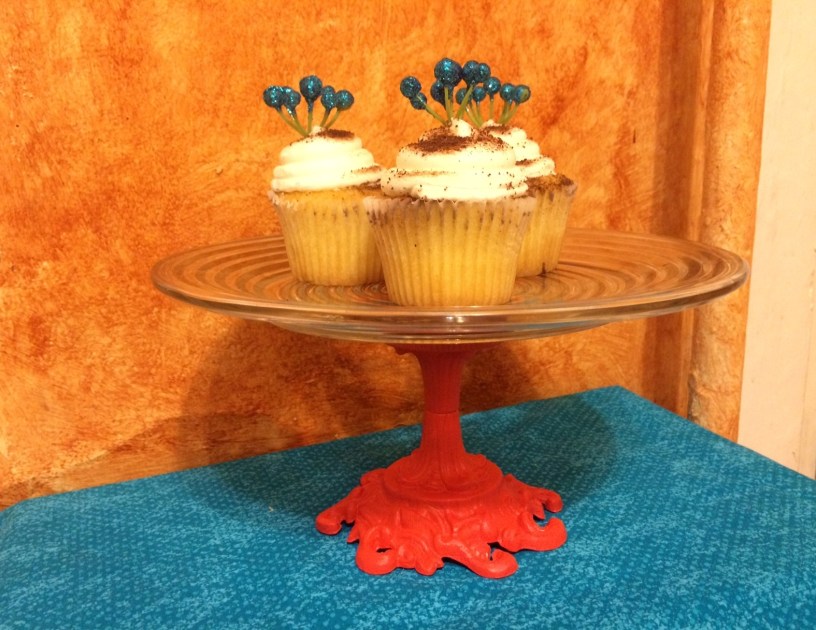
This is a quick and simple project, and a great way to create a unique pedestal cakestand that will (ahem) “elevate” your wedding (or holiday) pies, cakes, or cookies!

A few weeks ago in “Perfectly Imperfect,” I shared some of the thrift store finds I’m re-habbing to use as part of our wedding decor. First up, turning mystery object #7 and plate #2 into a cakestand with character. For those of you (still) wondering: mystery object #7 is a vintage toothbrush holder! It was obviously in need of a coat of paint, so I selected Valspar Signature, satin finish, in “Trolley” to coordinate with our wedding colors. (Note: A lot of hardware and home stores now mix and sell half-pint sample sizes, which makes it easy to purchase just the right color for a small project.) Continue reading

Image

Breaking Cake Together

Once we had a venue selected and booked, it was time to turn toward securing other vendors. The choice of where to focus next was obvious: the cake.

It’s all about priorities, people.

The tradition of wedding cakes, according to a fascinating history by Carol Wilson in Gastronomica, dates back to antiquity: “Ancient Roman wedding ceremonies were finalized by breaking a cake of wheat or barley…over the bride’s head as a symbol of good fortune,” after which the bride and groom would share a few of the crumbs. I’m certain many brides were grateful when this custom (also the precursor to modern-day confetti, says Wilson) morphed into a somewhat gentler crumbling of the cake over the head. Still, both rituals are a little too similar to the disturbing contemporary trend of the bride and groom shoving wedding cake in each others’ faces. Because nothing says I love you like frosting ground up your nose.

I’m equally glad we’ve moved beyond Yorkshire’s “Bride pie” (1500s-1800s), which Wilson describes as consisting of “a large round pie containing a plump hen full of eggs, surrounded by minced meats, fruits, and nuts” and decorated with “ornate pastry emblems.” It sounds like a cross between a Turducken and a fruitcake, and the fertility symbolism is a little less than subtle. According to Wilson’s history, it wasn’t until the late 1700s that a sweet cake finished with white icing became a common part of English wedding celebrations. Continue reading

Image

Steve Speaks: FsSTG meets FsFTB

FsFTB readers: Every so often my fiancé Steve will be chiming in with a post of his own—this is his first! 

Hello. My name is Steve, and I’m a fifty-something second-time groom.

I’m honored but somewhat intimidated to be invited to guest-blog here. I write a lot as a member of the forestry faculty at a state university, but what I write for work is mostly scientific and technical stuff about maps and carbon sequestration. Don’t worry—there won’t be trees or maps in this post! For balance, my forty-something first-time bride, Sandee, has invited me to tell my story, that of the fifty-something second-time groom. With two grown sons. And a dog. So to start: how can I discuss what the “second time” means without acknowledging the first time?

I was married in 1985 to Karen, a forester who worked in South Carolina when I worked in Georgia. We became engaged less than a year after we started dating, and there were fewer than six months between engagement and marriage. Quick, huh? I’d gotten a job offer in Alaska, which meant a compressed schedule for the wedding. We married in March in upstate New York, and our honeymoon consisted of a cross-continent roadtrip in a pickup truck with her golden retriever, followed by a three-day ferry ride from Seattle to Haines, Alaska, and a two-day drive from there to Anchorage. (Sandee and I don’t know yet where we’ll be going for a honeymoon, but let me go on record here as promising it won’t involve a dog and a pickup!)

Karen and I had twenty mostly very happy years together. The last twelve were under a slowly darkening cloud after she was diagnosed with multiple sclerosis. She died in January 2006, closing a chapter in my life and changing the nature of the family that remained: I became a single dad raising two teenaged sons. As it tends to do, time has healed wounds and filtered memories, so that most that remain are the good ones, and I look back on what we had with fondness, love, humor, and gratitude.

Steve&Tucker2

With oldest son Tucker

Fast forward: there’s this house on the end of my street. The yard is not very well kept. Holiday decorations appear only sporadically. Three guys, plus one canine (born male but subsequently modified), live there. Two of the guys are recovering adolescents; the other has gray in his beard as a result. It’s a testosterone-rich, estrogen-deprived zone, and you can tell it by the décor. And the state of the bathrooms. So, who is the guy who owns that house?

Well, I guess that would depend on who you ask. My neighbors see the guy with the unkempt yard. My students see a professor. My sons see a father, and my dog…well, judging by his greeting, I think he sees me as the center of the universe!

As I left my teens and progressed through adulthood, I tended to identify my “self” with the primary role I was playing at the time. I was a flannel-shirt-clad forestry student during college and graduate school. When we moved to Anchorage and our initial friends were all from Karen’s recreation-league soccer team, I became “Karen’s husband.” To those in the forestry company, I was the guy in charge of the number-crunchers in the technical department. When my boys started playing sports and joined scouts, I became identified as “Tucker’s Dad” or “Dusty’s Dad.” Returning to academia as a professor, I was the guy going up for tenure in his forties. Later, I became the guy who lost his wife. Continue reading